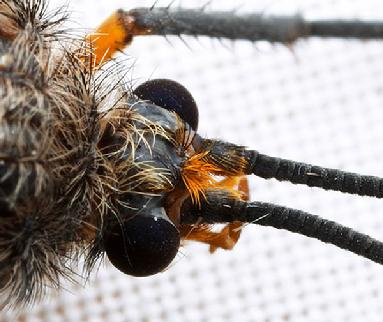
Trichoptera (Caddis Flies) - Caddis undergo complete metamorphosis, passing through four different stages during their life cycle. They start life as an egg, and then become larva; the larva will develop into pupa, and finally emerge as adults. Like mayflies, caddis can also be divided into different groups depending on the behavior. The larva behavior will define what groups the caddis belong to, free living, saddle case, net spinning, tube cased, and purse cased.
Free living caddis, like rock worms, spend most of their time in the water moving around and finding food. Most often rock worm larva will be a bit larger and fishing a C-Squared or T.L.C. in sizes 12 to 16 will mimic these tasty morsels. Saddle case caddis build cases around themselves built out of sediment and rock with an opening at each end. Net spinning caddis will build a net to catch their food as it drifts by, hence the name net building. If you try to remove these cases from the water, the net will not be visible. Tube cased larva will build portable cases constructed of woody debris and deciduous waste. Fishing a C-Squared in sizes 16 to 18 will produce plenty of strikes when these are available. The purse case larva is relatively small in comparison and is often called a micro caddis.
Caddis larva are virtually everywhere because of the ability to adapt to just about any water conditions from lakes to mountain streams. There was a time when caddis larva were largely overlooked by most fishermen as a food source for trout, but after so much success fishing the various imitations, they can not be ignored. Since caddis are unable to swim during this phase of their life, fishing these along the bottom in pocket water, riffles, or the pools just below them will be the most successful. The strikes oftentimes will be subtle, so keeping a tight line under your indicator will be critical to detect these strikes. To find out what larvae are living in the water you are fishing try picking up a few rocks. Most caddis larvae will set up colonies along the river bottom beneath the rocks. For the tube caddis you can determine what size and color they are by gently squeezing the smaller end of their cases toward the larger opening like a tube of tooth paste, the larvae size and color will be revealed. To determine what other species, as well as what size and colors are available to the fish in the water where you fish, look for the other types of structures I have previously mentioned and gently open them up at either end of their case. Many of these structures will look like tiny pebbles and sediment stuck to the bottom of the rock if you don’t know what you are looking for. Key times to fish larva and pupa imitations are from late April until runoff, and again after runoff, which depending on snow pack and rainfall will be sometime in late June. Often times the hatches will die off during the heat of the summer and pick back up at the end of the summer in September and even into October caddis hatches can be seen on most rivers and streams. Don’t overlook fishing larva patterns along the bottom at anytime of year, because as an attractor nymph I have had success even in the dead of winter. If nothing else is going on the water you can almost always find action fishing these. Fishing larva imitations after a rain storm when the water comes up and can be a little off color will prove to be very successful along the banks and on the shelves of the rivers where you fish.
The pupa stage will bring about great changes to the larva. The wing pads, legs, and antennae will develop which can take up to three weeks. The pupa will chew through its case and swim for the surface to emerge as an adult. Trout are well aware of these emerging pupa, and will take them from just off the bottom all the way up to the surface. Fishing pupa can be effective anytime of day but there are different ways of fishing them with success at different times. Early in the day and into the afternoon when you see adult caddis emerging it is most effective to fish them using the dry-dropper rig. The middle of the day is still an excellent time to fish a pupa as an attractor but you may want to get it down to the bottom using a double nymph rig. As evening approaches and the females return to lay their eggs, dropping a pupa off a dry will again be very effective, especially in the riffles and pocket water. Since the pupa actually swim quite fast to the surface, swinging these at the end of the drift can be deadly, so lift slow and hang on at the end of the drift. As the fly rises through he water column it is likely to trigger a strike.
Common names – Rock Worms, Sedge, Glossosoma, and Fall Caddis are some of the most common through out the west.
|