| Fishing Tips and Techniques |
|
Basic Nymphing Principles 101 "Wilcox style"
This nymphing style is just a general technique that has proven extremely effective; however there are variations and adjustments necessary to cover situations like winter midging and heavy water nymphing. As I expand the site I will expand the description you see here and add other nymphing methods like long light leader midging, and still water nymphing which will also be avialable in my new book "Synthetic Synergism" due out late 2008.
My saying about nymphing is "It is easy to learn to nymph fish, but it is hard to be good at it". Nymphing can take a lot of time on the water to learn the idiosyncrasies behind effectively nymphing and to get to the point where you just know what to do when you look at the water you are about to fish. I have taught many anglers this particular method and its general principles and within a matter of minutes they are getting into fish and catching more than they ever have. In my new book, I will be adding much more detail on exactly how to fish this method from where to cast and how to retrieve complete with illustrations and photos to achieve maximum results. The book will also further illustrate how to adjust the weights correctly and types of leaders and tippet lengths for the water you are fishing so look for it in 2008. One of the biggest errors I see made amongst anglers attempting to nymph fish is not using enough weight to get the fly down. I believe patterns like my Superman or John Barr's Copper John have so much success, due to the fact they have enough weight tied into them to get the fly down for the angler without the absolute necessity of adding additional weight. Dummy proof, if you will. Sure, they are great patterns but at the end of the day they are just flies and fishing them correctly, no matter what they are is of the utmost importance, having enough weight built into the fly to get it down goes a long way towards fishing them correctly. Take the time to adjust your weights for different depths and different water conditions; you will catch many more fish than the lazy person who is unwilling to change. I will vary my weight greatly through out the day and even within the same run, I can't tell you how many times adding or subtracting one small weight has yielded several more fish in the same spot I have been working for 20 minutes without a strike. I never fish straight nymph rigs without fishing a double triple or even a quadruple nymph rig (not recommended for the novice angler, but with practice you too can fish four at a time in what I call the buffet) Why do I fish the multiple nymph rigs as opposed to one or two you might ask? Since hatches of different species overlap and fish can be keying in on baetis nymphs even when you see caddis hatching and are unaware of what they are actually feeding on, so fishing multiple species and attractor patterns can be the most effective until you narrow down which insects the fish are keying in on. If you catch four fish in a row on one pattern than chances are you should focus on that particular species of insect, but beware because about the time you get it figured out they might start keying in on the next tray on the buffet line. As a general rule of thumb, I will tie the trailing flies off the bend of the hook of the first fly and so on down the line leaving about 18" of tippet between flies and tapering the weights, fly sizes and tippet diameter as you go down the line. This tapering helps to turn the flies over and leads to less tangles. Nothing is more frustrating than fishing multiple fly rigs and finding yourself all tangled up. I have found by tapering the whole rig like a leader, from largest to smallest, you can eliminate most of the frustration. This method assumes you have basic casting skills (if you have never cast before or are just beginning keep it to one fly to get started and then add a fly as you feel comfortable, shorter and heavier tippet sections between flies may make the system less effective but much easier to cast). I'll give an example of the rig I might use on any given day on any given river with great success. Tie on a 7.5' 3X leader with another 24" of 4X tippet and then tie on the largest fly in your buffet, like a size ten Wilcox's Microstone with a size four weight aprox. 6 to 10" above the fly. Placement of the weights will determine where the fly rides in the water, if you place the weight 6" above the fly the fly will likely bounce right along the bottom, if you place the weight 12" above the fly it will likely hover over the bottom from 2 to 6" depending on the current. Adjust the placement of the weight according how you want the fly to drift in the water. Next tie on about 18" of tippet to the bend of the Microstone leaving enough extra tippet to tie on another pattern like a size fourteen T.N.T.. Now you have tied two flies on that represent a stonefly imitation and a caddis imitation. Now add a small split like a size six split to the tippet aprox 6 to 10" above the T.N.T. this is what I mean by tapering the weights and the fly size as you go. Now you are ready for the third fly, tie on another 18" of tippet, again leaving enough room to tie on something like a size 18 Little Green Machine. Now you are covering Stoneflies, caddis, baetis and midge species! Add a size eight split shot 6 to 10" above the LGM to complete the tapering effect. Weights and sizes will obviously vary according to depth and speed of the flow you a re fishing but this gives you the basic concept. You are covering just about all the possible food sources and your odds of catching fish will greatly increase. When casting multiple fly rigs such as these be sure to allow enough time for the leader to straighten out behind you…as with any cast timing is crucial to avoid tangles and frustration but is amplified with multiple fly rigs. If you begin your forward stroke to soon, you will likely wind up tangled and frustrated. If you were using an indicator, another general rule would be to place the indicator up your leader to aprox. 1.5 X the depth of the water you are fishing, like any other generality this will vary with water conditions. Start with two flies and work your way up I have ended my quest at four fly rigs…maybe some day I'll try five but even I am not that brave. Hahahaha. Any questions??????
|
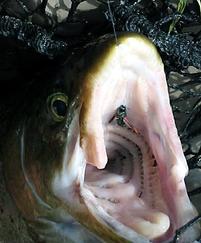 |
| Wilcox's Woven Water Boatman (3WB) is delicious! |
|
|
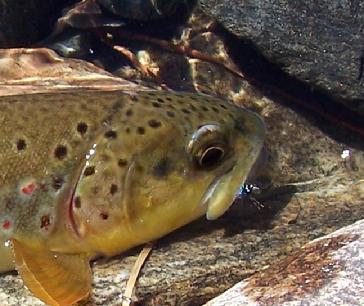 |
| I love the taste of a good T.N.T. |
|
|
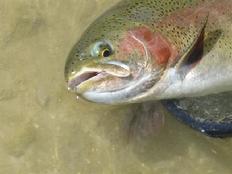 |
| I find size 16 Little Green Machines to be a delicacy. |
|
|
|
