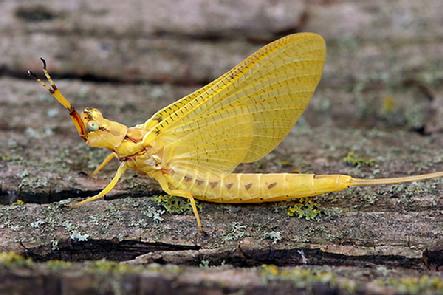
Ephemeroptera (Mayflies) - Mayflies do not undergo complete metamorphosis because the larva and pupa stage of their life is condensed into one nymphal stage, they will undergo three stages in their life cycle, which is called incomplete metamorphosis. They begin life as an egg, spend most of their life as a nymph, and complete the cycle when they emerge as adults. Mayfly nymphs consist of four different groups. There are burrowers with long oval shaped bodies and have a set of mandibles that are like pinchers and are visible at the front of the insect. Clingers have flattened bodies and the abdomen is narrower than the head. Swimming nymphs have more cylindrical shaped bodies and have visible hair like fibers on their tails to help them swim through the water. Crawlers are identifiable by their head size being less than the width of the abdomen in most cases, and most often they will lack visible mandibles. Each nymph is adapted to the area of the water in which it lives; the clingers for instance have flattened bodies to reduce drag on their bodies so they can “cling” to the substrate where they live. Most often you will find these nymphs beneath the rocks in riffles, and in the pocket water. These nymphs are always available and will vary in size according to the water temperature and species. Early in the season (February-May) the majority of the nymphs available to the fish will be around size 18 to 22. As the season progresses (June-August) the nymphs grow in size and will likely be size 12 to18. In many of the lakes you will find Callibaetis nymphs which tend to be a bit larger, size 12 to16, as well as the various Drake nymphs which will also be on the larger end of the spectrum. When fall weather sets in (September-November) a combination of shorter days and cooler temperatures will slow the growth rate of the nymphs, and once again the majority of the ones available to the fish will be size 18 to 22. Fishing baetis nymphs like the Little Green Machine and Marabare is productive at almost anytime of year when fished along the bottom. In many of the lakes and slow moving streams from the east to the west you will find the Hexagenia Limbata, which can be as long as two inches! Hexagenia adults can take up to two years to mature inside their burrows at the bottom of the lake, molting dozens of times in the interim. The best fishing when imitating these is most often in ten feet of water or less, and fishing a Hex-Nymph pattern along the bottom, on a slow retrieve from 7:00pm until dark, can be very effective. Mayfly adults will go through two different stages after they emerge as adults. The dun stage is the stage most fishermen are familiar with. Oftentimes after emerging the adults will rest on the waters surface until their wings are ready for flight, while at rest they look like little sail boats and can be quite visible to the fisherman as well as the fish. These emergers can become very vulnerable to the fish as they are trying to dry out their wings and take flight, and most often opportunistic fish will feed on these as well as any cripples that didn’t quite develop enough for take off or have been knocked down by the wind. The spinner stage of the adults will begin several hours or days after emergence when the dun is mature enough to mate, its wings will be clear and they will return to the waters surface in swarms. After mating, the females will deposit their eggs, mostly on the waters surface, and after dropping their eggs will fall to the water as “spent spinners”. This stage of the hatch can be difficult to fish because their clear wings make it difficult for you to see them on the water. Oftentimes fish will key in on these spent spinners because they are helpless targets. Competing with the millions of naturals on the surface after a Trico hatch, for instance, can be a very humbling experience. Fishing a sunken spinner at this time can be a deadly tactic, it may appear as though the fish are rising to surface insects when in fact they are most often taking the ones that have broken through the surface film and are drifting about in the current below the surface film. During the next Trico hatch try fishing a cream or chartreuse bodied Little Green Machine just under the surface for some ridiculous fun!
Common Names - There are so many different species of mayflies it would fill a page, but I will list some of the common names of the ones you are most likely to encounter wherever you fish. There are Blue Winged Olives, Brown, Gray, and Green Drakes, Pale Morning Dun, Pale Evening Dun, Tricos, and various colored quills mostly consisting of yellow and red quills.
|